
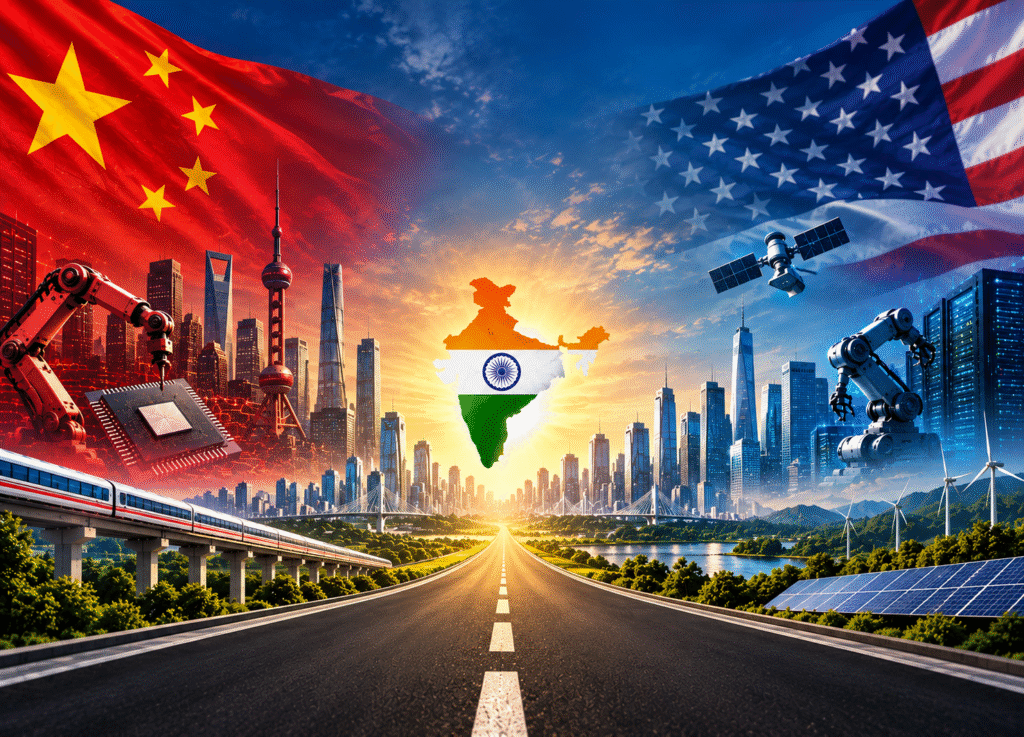
In the 21st century, the global political economy and international trade relations are increasingly determined by the role of emerging technologies and the resources required to develop and integrate them into each state’s defence and commercial capacity. A race to develop and master these technologies has been set off among major economic and industrial powers due to heightened fears of technology weaponisation and vulnerabilities caused by dependencies, data sovereignty issues, and export control regimes. Amid the Sino-US race for critical technology dominance, this essay examines how India’s investment in building a Critical and Emerging Technology (CET) ecosystem impacts its long-term development vision of Viksit Bharat@2047.
Introduction
Emerging challenges such as global pandemics and climate-related disasters pose imminent threats to the global economic and political discourse in the 21st century. The COVID-19 pandemic brought transnational connectivity and the flow of people and goods to a standstill, adversely impacting international trade and commerce. The development of CETs enables cutting-edge data-linked solutions to address these challenges. CETs are advanced, next-generation technologies with disruptive capabilities that can enhance or disrupt socio-economic life and security. Presently, developed powers such as the United States and China lead in developing these technologies and control the raw materials integral to their development.
Sino – US Race for Critical and Emerging Technologies
According to the Critical Technology Tracker Index published by ASPI (report based on high-impact academic research and patent output), by 2023 China leads in 57 of the 64 technologies that are categorised as CET, while the US leads in 7 technologies. During 2003-07, China led in 3 technologies while the US led in 60 of 64 technologies during the same period. This change was brought about by decades of investment in Research and Development (R&D) by China, which currently maintains a considerable lead in quantum technology, clean energy, and advanced integrated circuit design/fabrication. In 2024, China overtook the US as the largest investor in CET development, investing $859 billion in CET research, development, infrastructure, and capacity building, surpassing the US, which stood at $848 billion according to OECD indicators (MSTI Database, OECD, 2026). This lead is the result of long-term policy planning, deliberate efforts to develop Military-Civil Fusion and concentrated state-led efforts to develop the domestic STEM industry, with the aim of achieving technology self-reliance and technology domination.
Although China’s efforts to scale up its domestic technology ecosystem have enhanced its technology capabilities to near-parity with those of the United States, the US is still arguably the pre-eminent global power in CET. According to the Belfer Centre – Critical and Emerging Technologies Index, the United States maintains a decisive lead in the foundational pillars of future power, including high-performance computing, large-scale AI frameworks and advanced chip design and integrated circuit design. The United States spends nearly 3.4 – 3.5% of its GDP on research and development, one of the highest shares globally and recruits talent from around the world to create a robust research and development ecosystem by providing a conducive environment for the development of advanced technologies.
While the US remains a global technology and innovation giant, the future of US technology dominance is inconclusive, with China as a near competitor and, in several cases, surpassing the US in key technologies. At present, China and the United States maintain a near duopoly in the global race for critical technologies, leaving middle countries such as India in a distant 3rd place. With a large and relatively young population and an educated and tech-savvy workforce, India emerges as a rising but significant player in this new Cold War between the United States and China. According to ASPI, India ranks among the top 5 countries in 45 of these 64 technologies, and second in 7, even displacing the US from second place in biological manufacturing and distributed ledgers, making it a natural contender for critical technology development. As part of this rise, the Indian government has explicitly identified the role of critical and emerging technologies in their national development roadmap, i.e. Viksit Bharat-2047.
India’s Viksit Bharat Aspiration in a Techno-Nationalist Order
Viksit Bharat (2047) is India’s long-term strategic development framework for transforming the country into a developed nation by 2047. A primary objective of the vision is to transform the country’s economy to a high-middle-income per-capita GDP by 2047. Emerging technologies – AI, Quantum technology, Semiconductors, Space, Biotechnology, Cybersecurity, Advanced Telecom connectivity – are direct enablers of a country’s development trajectory. Programs such as the India AI Mission, India Semiconductor Mission, National Quantum Mission, and the Bio E3 policy are among the policies under implementation to foster tech-driven economic growth. Viksit Bharat-2047 mission focuses on economic growth, social development, and technology-integrated delivery of public goods, thereby making emerging technologies a key component for the realisation of this national development roadmap.
Although India has been rapidly advancing its efforts to develop its domestic industry’s R&D capacity and to integrate its market into global technology supply chains, R&D investment by India lags far behind that of China and the United States. India invests nearly $75-$80 billion in emerging technologies R&D as opposed to the US and China’s collective investment of $1.5 trillion in the global R&D pool of $2.8 trillion. A similar disconcerting trend is the considerably lower level of private-sector investment in developing emerging technologies, accounting for only 36% of national expenditure on technology R&D, of which the majority goes to the development of generic pharmaceutical drugs. These statistics pose numerous challenges for India in the context of global big-power competition.
While India possesses strong human capital and data births, the national technology potential is unrealised due to a limited domestic research base for niche technologies. India contributes only 6.96% of high-impact research in critical and emerging technologies while China contributes nearly 48.49%. This deficit can impact India’s innovation progress and, broadly, its strategic autonomy by exposing India to geopolitical volatility, underscoring the vulnerabilities India may face due to high dependence on foreign-origin technology and supply chain constraints.
Implications for Viksit Bharat – 2047
A technology-enabled society by 2047 depends on becoming a producer of critical and emerging technologies through technology adaptation, industrial innovation, and the establishment of innovation-driven policies. However, the present R&D investment appears weaker than that of the United States and China. Weak private-sector investment in R&D and an underdeveloped advanced hardware ecosystem (metallurgy, superalloy manufacturing, advanced propulsion, etc.) reinforce structural bottlenecks in India’s capacity to capture critical technology value chains. India’s relatively weaker standing in these areas could affect its growth in high-impact technology sectors like quantum computing and advanced semiconductor fabrication. Although India projects strong growth in IT services and software development, and has shown substantial growth in attracting investments in sectors like AI and semiconductor manufacturing, this growth remains fragmented and has not led to the development of a holistic ecosystem for critical value chain technologies. This imbalance can affect India’s growth trajectory and put it at a disadvantage compared to leading powers such as the US and China.
● R&D Gaps
Low R&D intensity can create innovation lags for India, putting it at a greater disadvantage amid the US-China rivalry. To achieve an annual growth of 7% – 8% and ensure a nominal GDP of $30 trillion, India requires concentrated, large-scale investment in technology R&D. To compete with the US and China, R&D investments need to be scaled up to their aggregate standard – 2.2 %-2.5% of GDP spending as opposed to the current 0.7%. Without the requisite investment in R&D, research output rivalling global competitors cannot be achieved, and innovation growth will be stifled. This scenario will be detrimental to the growth of a developing economy like India.
● Negligible Academia–Industry–Institutional Integration
Integration between universities, research labs, and industry stakeholders remains limited and fragmented in India. National policies focused on holistic interlinkages between Academia and Industry need to be implemented to ensure active engagement between stakeholders and to foster collaborative partnerships. India’s academic systems are not integrated as they are in Europe or the US, and this poses significant challenges to ensuring a thriving academic discourse for the development of niche technologies. Bridging the gap between universities, industry stakeholders, and institutions is an essential factor in determining the scale of innovation and research output, especially in high-impact technologies. Capacity building through skill development centres and GCCs (global capability centres) can help foster a more passionate and driven research landscape and innovative workforce.
● Balance Open‑Innovation with Sovereign‑Security
Growing animosity between US market-oriented technology philosophy and Chinese state-controlled policy can lead to increased confrontations in the future. The growing polarity between opposing models will have implications for middle states like India. Developing countries, like India, rely on advanced foreign goods and technologies (like tunnel boring machines, sub-7-nanometer nodes, etc.) to foster greater domestic industrial capacity. Geopolitical power struggles can have significant spillover effects on middle power states like India. Competing technology development philosophies will gain increased traction as influential efforts force stakeholders to adopt a particular approach. Middle powers like India are best advised to walk a strategic tightrope without unequivocally supporting any particular side. Although critical technology discourse has not reached a stage where it divides states, the rise of technology grandstanding and big power competition creates an environment in which all potential outcomes need to be accounted for.
Conclusion
National innovation systems theory emphasises that the interaction between private companies, academia, and public institutions determines how effectively investments translate into capabilities. The United States and China have created robust and innovative CET ecosystems, which contribute significantly to the maximisation of their national strength. The disparity between India and technology leaders such as the US and China has already led to a state wherein this gap has become a disconcerting determinant in their respective bilateral relations. Additionally, this disparity has created an environment where these leading powers are already shaping global technology standards for AI ethics, data governance, and cyber norms, often within venues India can only partially influence. This imbalance has created a hierarchical dominance through leverage and influence between the leading powers and the rest, often creating a dynamic of rule-maker and rule-taker. This will have implications for the extent of India’s influence in the international discourse on technology standards and development models. In order to address these challenges and develop a thriving domestic techno-industrial base, India will have to pursue, on a war footing, a national mission aimed at achieving a reformed regulatory framework, effective patent-filing mechanisms, addressing funding gaps for high-impact technology research and labs, and the creation of local supply chains to bridge R&D with the commercial actualisation of these technologies.
Disclaimer
The views and opinions expressed in this write-up are solely those of the author and do not necessarily reflect the official position of Renaissance International Review, its management, editors, or platform.
While the facts and figures presented have been cross-checked by the editorial team to the best of their ability, readers are encouraged to independently verify information where necessary.
For any concerns, clarifications, or objections regarding the content, please contact: contact@rir.world