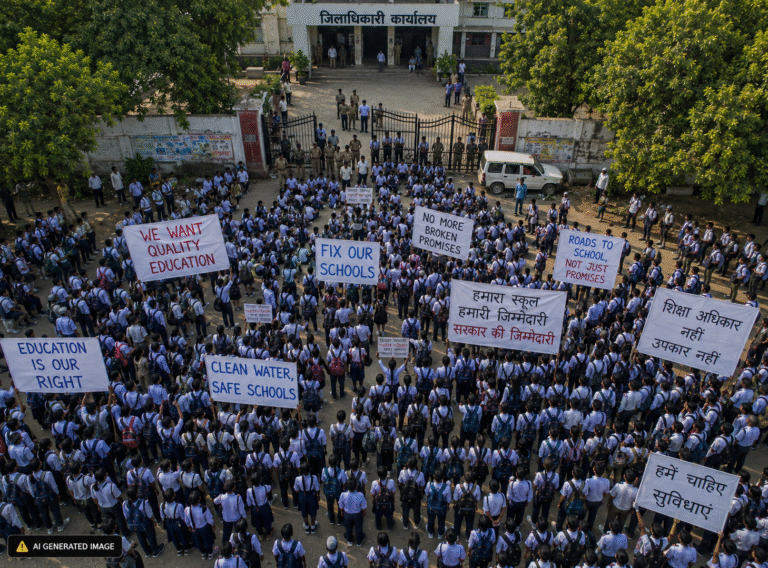

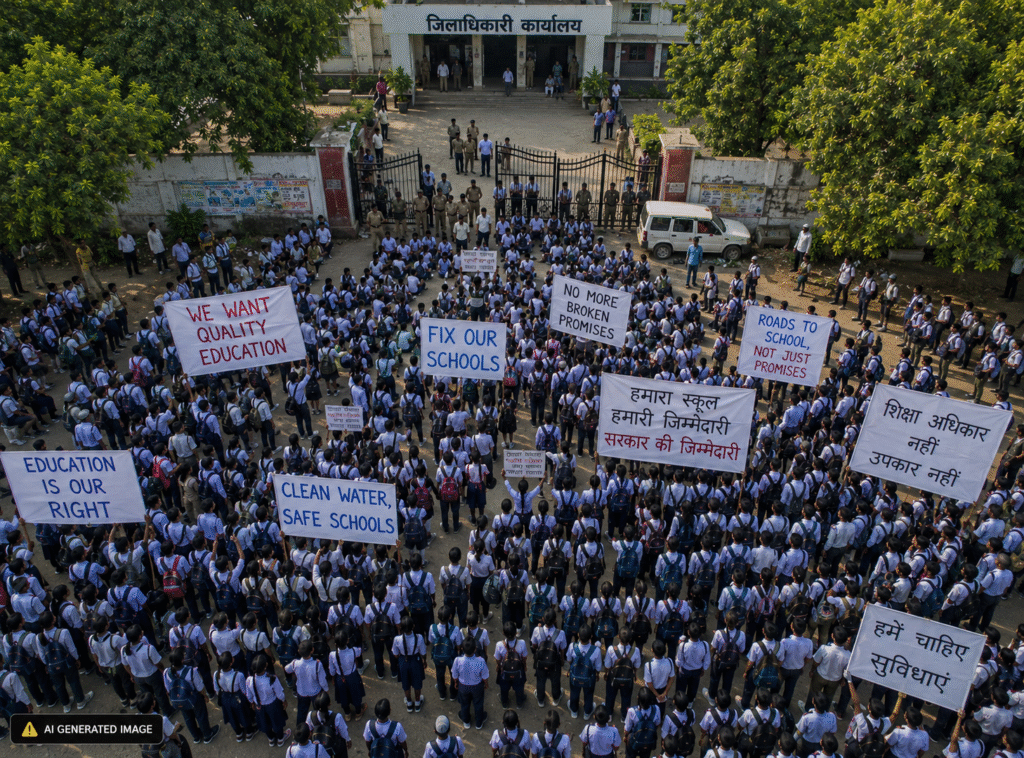
India may be witnessing the beginning of something bigger than a series of scattered school protests. What began as a Gen Z-driven political and student mobilisation around the NEET examination controversy has now found an unexpected echo among much younger Indians. In recent weeks, schoolchildren in Uttar Pradesh, Bihar, Rajasthan, Madhya Pradesh and Maharashtra have walked out of classrooms, marched to government offices, locked school gates and staged sit-ins, demanding things that should never have required a protest in the first place.
The connection is difficult to ignore. The Cockroach Janata Party, led by 30-year-old Abhijeet Dipke, emerged from the anger of India’s digitally connected youth and turned online frustration into street mobilisation. Its prolonged protest at Delhi’s Jantar Mantar over NEET-UG irregularities eventually became a major national political story, with Education Minister Dharmendra Pradhan resigning on July 25 after weeks of demonstrations.
That success may have unintentionally taught a much younger generation a powerful democratic lesson: when institutions do not listen, visibility and collective action can force them to respond. And Gen Alpha is now experimenting with that lesson.
In Fatehpur, Uttar Pradesh, hundreds of students at Sarvodaya Inter College protested over electricity, fans, drinking water and classroom furniture. The administration issued assurances after the students took to the streets. In Hamirpur, children travelled around five kilometres in a Tiranga Yatra before sitting outside the Collectorate and demanding a proper road to their school. During the monsoon, they said, reaching school meant walking through mud because the promised road had remained unfinished for decades.
Elsewhere, the demands have been equally basic. Students in Bihar have raised concerns about toilets, drinking water, broken furniture and the quality of midday meals. In Rajasthan, students have protested teacher shortages. In Madhya Pradesh, students at a residential school complained about poor food quality, including allegations that insects had been found in meals.
At one level, these are local administrative failures. At another, they reveal something deeply uncomfortable about India.
India is one of the world’s largest and fastest-growing economies. It speaks confidently about becoming a developed nation, building global infrastructure, creating digital public systems and becoming an economic powerhouse. Yet, in many parts of the country, children still have to protest for a functioning toilet, a fan in a classroom, a teacher, clean water, a decent meal or a road to school. These are not luxury demands. They are the minimum conditions required for education.
That is why the emerging Gen Alpha protests deserve attention beyond their immediate headlines. A child demanding a road to school may appear to be a small local story. A group of teenagers demanding fans may sound insignificant compared with national political battles. But together, these protests point towards a generation that is becoming less willing to accept administrative failure as normal.
Gen Alpha has grown up watching everything through smartphones. They have seen protests become viral, watched governments respond to public pressure and learned that an apparently ordinary grievance can become a national conversation within hours. The language of protest is no longer something reserved for trade unions, political parties or older student organisations. It is becoming part of childhood civic experience.
There is, of course, a legitimate question about how much of these protests are independently organised by children and how much involvement comes from parents, activists or political actors. That question must be examined seriously. But questioning the origins of a protest should not mean dismissing the grievance itself. The real warning for governments is simpler.
Children should be inside classrooms demanding better education, not outside government offices demanding the basic conditions necessary to receive it.
The larger impact of the CJP protest may therefore not be the resignation of one minister. Its more lasting impact could be the idea it has passed down: questioning authority is possible, collective action can work, and even people with little formal power can demand accountability. For Gen Alpha, that lesson has arrived early.
And perhaps the biggest question India now needs to answer is not why these children are protesting, but why they had to protest at all.
Disclaimer
The views and opinions expressed in this write-up are solely those of the author and do not necessarily reflect the official position of Renaissance International Review, its management, editors, or platform.
While the facts and figures presented have been cross-checked by the editorial team to the best of their ability, readers are encouraged to independently verify information where necessary.
For any concerns, clarifications, or objections regarding the content, please contact: contact@rir.world