
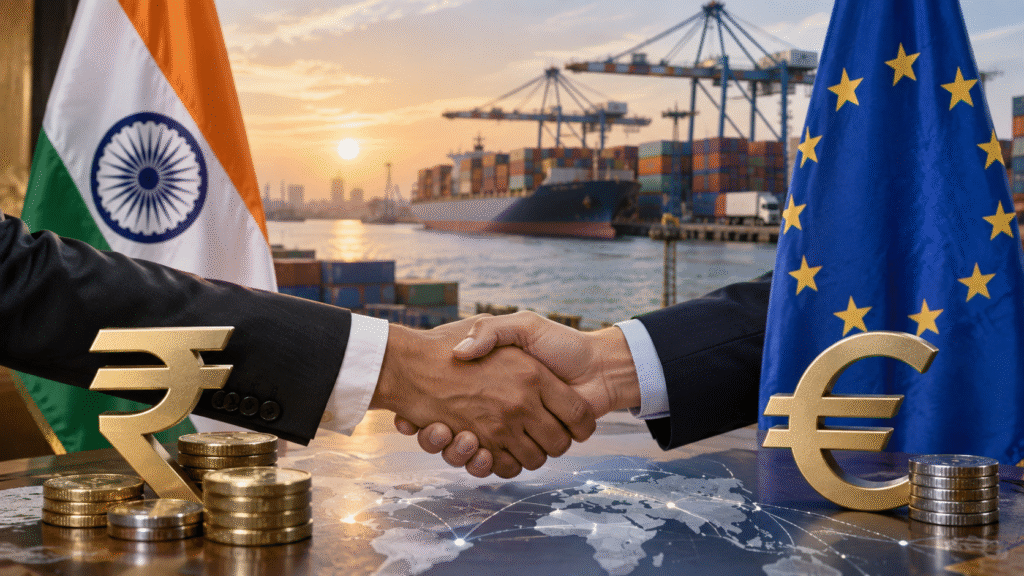
Trade Deal with Strategic Depth
The long-awaited India-EU trade deal was signed on 27 January this year, generating considerable international attention due to the magnitude of its impact on the Indian and EU economies, and is being described as the “mother of all deals”. The inking of the deal is a major milestone for both partners, but the impact goes beyond the nuances and tariff reductions. It is happening at a juncture of global power politics when every single economic tool is being weaponised through sanctions, export controls, and supply-chain realignments. This is a classic example of looking beyond traditional Western economic alignments, to new economic and strategic partnerships. If the EU is trying to de-risk from China and the United States without decoupling, India is trying to rise as a trusted partner in manufacturing with alternative technologies. The agreement speaks volumes about economic security which is now inseparable from national security for all partners.
U.S. Factor and India’s Strategic Autonomy
As a major player in the geopolitical arena, the United States remains a key strategic partner of India in the Indo-Pacific region, specifically when it comes to countering and balancing the Chinese ambitions and designs. But in the current context where the U.S. foreign policy is undergoing rapid changes, the India-EU trade deal indicates that the Indian foreign policy does not revolve solely around Washington,D.C. For India a strong relationship with the European Union which comprises 27 member states, strengthens its doctrine of strategic autonomy and national interest. New Delhi is engaging with Washington, D.C. on security matters, while safeguarding its own national interests at home and abroad. The deal with the European Union delicately fortifies India’s global relationships which are diversified— if it is economic integration with the EU, it is strategic security with the U.S., defence and energy cooperation with Russia, and trade and natural resource relations with West Asia. This multi-pronged diplomacy strengthens India’s leverage in the geopolitical arena.
Multipolarity in Play: India’s Expanding Options
Today India’s foreign policy reflects an understanding that the global political order is decentralising rather than consolidating in one direction. The trade deal fits right into this image of broad patterns- engaging in the Quad, strengthening BRICS, resolute in the relationship with Russia, deepening ties with the Gulf countries, and Central Asian states even to the extent of defense relationships, signals one clear message. India is broadening its strategic bandwidth, rather than exclusively revolving around a single bloc.
This trade agreement is the answer to the multi-alignment India is trying to achieve. It portrays how an emerging country like India can function smoothly in multiple economies without facing problems, and how it is a strategy to reduce vulnerability of depending on one single power that is weaponizing economic tools for its own national interest. In this sense multipolarity is not just an ideology but a diversification in foreign policy engagement and structure.
South Asia and the Indo-Pacific: From Periphery to Pivot
The structural diversification India is eyeing through this trade deal is elevating the strategic importance of South Asia. As we currently witness the outflow of global companies from China, India — and by extension South Asia — are becoming a central logistical and manufacturing hub for the region. It should also be noted that the rapid infrastructure development in India is attracting different partners to engage systematically, which reinforces India’s role as an anchor economy and paves the way for reshaping the regional economic dynamics.
Adding to this layer is the elevation of the Indo-Pacific, which is gaining more traction in global politics through a series of interactions especially from the European partners and their presence in the region. The increased naval and military presence of European countries highlights how much Europe values the Indo-Pacific and its maritime trade routes which are vital for its growth. For India, its interest in the region is dual in character, securing its maritime trade routes and countering China in all its plays. Through the trade deal, India has not only inked an economic path for prosperity but also designed an avenue for future engagement with its European partners for maritime security, emphasising connectivity, sovereignty, and rules-based maritime order.
Road Ahead
This historic signing proves that it is possible for India to rise on the global stage sooner than expected, but the success of the trade deal is determined in its implementation. As European regulatory frameworks are stringent, India will need to play a balancing act by taking into confidence its domestic market sensitivities with export ambitions.
It also comes with a geopolitical balancing. As India deepens its long-term engagement with its European partners, India should not compromise on its historic and strategic partnerships with Russia and states in the Gulf, as India’s foreign policy is unique in its engagement with partners who are standing on opposite sides of geopolitical interests. On the other hand, Europe will have to manage its own internal divisions concerning trade and strategic engagement.
At the end of the day, one signal is unmistakable: India is no longer a mere spectator on the geopolitical stage, it is going ahead in its aspiration of creating a multipolar world order which is flexible, diversified, and influence is defined by strategic partnerships. The India-EU trade deal is a manifestation of this aspiration.
Disclaimer
The views and opinions expressed in this write-up are solely those of the author and do not necessarily reflect the official position of Renaissance International Review, its management, editors, or platform.
While the facts and figures presented have been cross-checked by the editorial team to the best of their ability, readers are encouraged to independently verify information where necessary.
For any concerns, clarifications, or objections regarding the content, please contact: contact@rir.world