

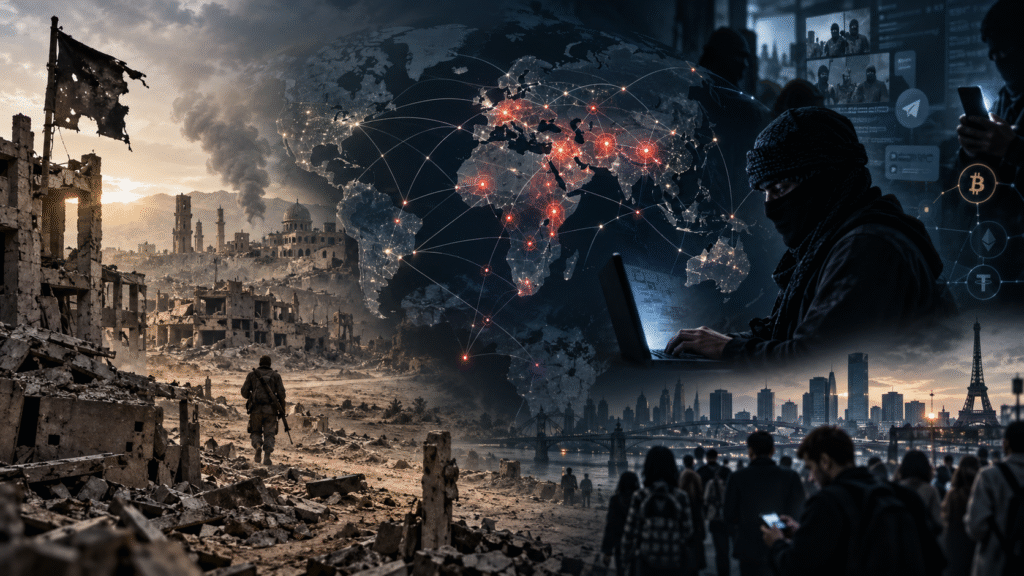
Defeat and Resurgence
The Islamic State of Iraq and the Levant or shortly known as ISIS controlled large areas in Iraq and Syria amounting to approximately 230,000 square kilometers of land and proclaimed it as the Islamic Caliphate under the leadership of Abu Bakr al Baghdadi. The 2019 counter-offensive against ISIS by the coalition forces of more than 80 countries is seen as the final stand against the ISIS and the disintegration of ISIS. The perceived notion of the total disintegration and weakened ISIS is fading due to the recent events around different parts of the world. ISIS is on a path of resurgence in a decentralised structure but with a resilient behaviour. This is reflected in the attacks by its lethal affiliate ISIS-Khorasan functioning from the Khorasan region in Afghanistan, who claimed the attacks on 22 March 2024 in a concert hall in Moscow and the bombing in Kerman, Iran on 3 January 2024. When there is a threat posed by ISIS- K in South Asia and Central Asian region, the instability and power vacuum in many African states have allowed ISIS cells to grow and entrench themselves in many fragile states, while the group’s cells are in a low intensity growth in Iran and Syria.
The formation of local affiliates and reactivating cells across different parts of the world should be seen as the next stage of resurgence of ISIS and its operations worldwide which speaks volumes on its transformation from a centralised caliphate to decentralised global network.
Caliphate to Decentralised network
The disintegration of ISIS and its self-proclaimed Caliphate in 2019, which was followed by the death of its supreme leader Abu Bakr al Baghdadi, the international community at large believed that the organisation was dismantled and dismembered, but the notion of defeating an enemy who controlled large parts of Syria and Iraq was challenged once ISIS started to show its resurgence and resilience. The mushroom growth of local affiliates in different regions is the prime proof that ISIS and its operational network remain largely active.
In Africa the formation and activities of Islamic State’s West Africa Province (ISWAP), and the Islamic State’s Central Africa Province (ISCAP), followed by the vigorous activity of ISIS in its earlier formed five official provinces—or wilayat—in Africa: three in Libya and one each in Algeria and the Sinai Peninsula in Egypt portray the slow and steady growth of ISIS local affiliates in the African belt. Meanwhile in its home ground the remaining ISIS leadership and the leftover fighters did a strategic withdrawal from their strongholds to desert pockets to sustain the movement at large by continuing their activities through propaganda apparatus, sleeper cells across the world, and pursuing attritional warfare.
The tactics of dispersing its operational base into decentralised structure by empowering local affiliates and insurgent groups is helping the ISIS at large to stay relevant in its presence, operations and propaganda of its ideology even when it lacks a concrete state structure which collapsed in 2019.
Global Threat Landscape in the Digital World
The slow but steady resurgence of ISIS in different parts of the world should be taken as a concern and threat to global security structure. The decline of the caliphate did not pave the way for a complete collapse of the ISIS organisation was transformed into a hybrid globally networked threat. This analysis stems from the organisational changes that seemed to have happened in the organisation, in which there is regional autonomy with centralised oversight. The ISIS affiliates namely the ISWAP and IS-Sahel now control and occupy the fragile regions which are areas conducive to its operations by exploiting the weak governance and security gaps. This is catalysed by the changing structure of its use of modern technologies.
In the changing world scenario, ISIS also evolves and adapts to the changing situation, by using the digital platforms and artificial intelligence. The new operations of ISIS are heavily dependent on its engagement on digital platforms that gives the organisation more room to execute its missions all across the globe, which also includes the use of different digital financial tools including cryptocurrency for its operations worldwide. It is also a key pillar of its strategy to maintain global influence, project power, and advance its ideological and operational goals. In the digital world ISIS use AI generated propaganda to messages that cannot be traced back, to recruit and radicalise mainly young people who are vulnerable to many factors at play. This hybrid strategy that ISIS uses in the current scenario calls for an immediate action to thwart any moves in the digital world by the Islamic State operatives. If not react now, this gives ISIS ample room to operate without trace, which will give them the means and resources to destabilise regions across the world through local autonomy, durable insurgent tactics, and sophisticated digital structure for their outreach.
Countering the Resurgence
The effective methods to counter the resurgence of ISIS require a multi-pronged approach which addresses the strengthening frontline fortifications mainly in the digital world, strengthening of regional stability, and finding solutions to structural vulnerabilities at the local level.
Immediate measures should include, collection and sharing of local intelligence across borders among all parties in the fight against ISIS, which will help in thwarting any threats mainly from ISIS-K and ISIS affiliates in the African region which use regional instabilities and power vacuums as a catalyst for their operations and growth. This is followed by digital governance to trace and thwart any suspicious activities in the digital world, which can be effective in preventing digital-based recruitment and funding networks. Finally, addressing local realities, which are seen as factors contributing to radicalisation, including governance reform, political inclusion, which represents the voices of all communities, providing basic services, economic and social development, and finding solutions to unemployment, hunger, and poverty in local communities to undercut the appeal of extremist groups.
Conclusion
The re-emergence of ISIS in global security discussions demonstrate that the defeat in 2019 did not lead to its eradication. What existed before as a centralised caliphate has now re-emerged as a highly decentralised organisation with local affiliates thriving across ungoverned spaces and the online world, and adapting to local realities for its operations. From Moscow to Kerman in Iran, from the Sahel to South Asia, ISIS still spreads violence. In particular, the threat of ISIS-K in the South Asian region should be taken seriously, as it continues to grow in the radically fertile land of Afghanistan by projecting influence and fuelling radicalisation around the region; if not contained, it might lead to the repetition of history that we witnessed in Iraq and Syria. Addressing this ever-evolving situation requires a multi-pronged strategy. The counter-terrorism military operations should go hand in hand with intelligence cooperation, governance reforms, counter- radicalisation strategies and meeting the needs of local populations, which undermines the growth of ISIS at its roots.
Disclaimer
The views and opinions expressed in this write-up are solely those of the author and do not necessarily reflect the official position of Renaissance International Review, its management, editors, or platform.
While the facts and figures presented have been cross-checked by the editorial team to the best of their ability, readers are encouraged to independently verify information where necessary.
For any concerns, clarifications, or objections regarding the content, please contact: contact@rir.world