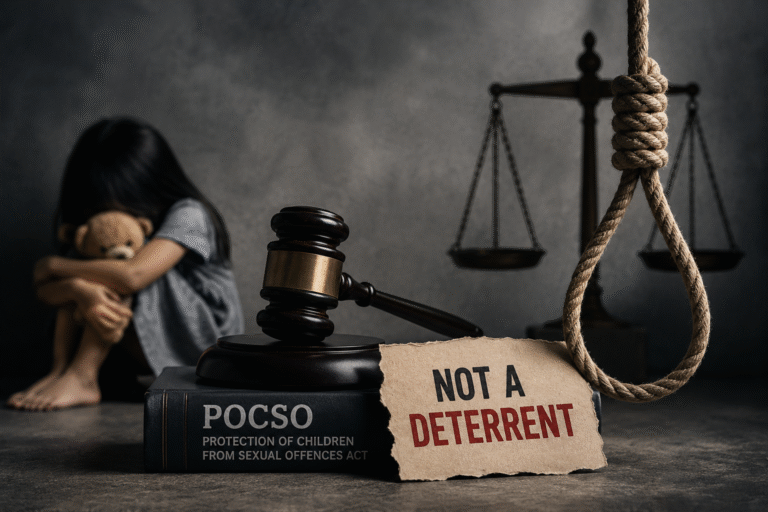

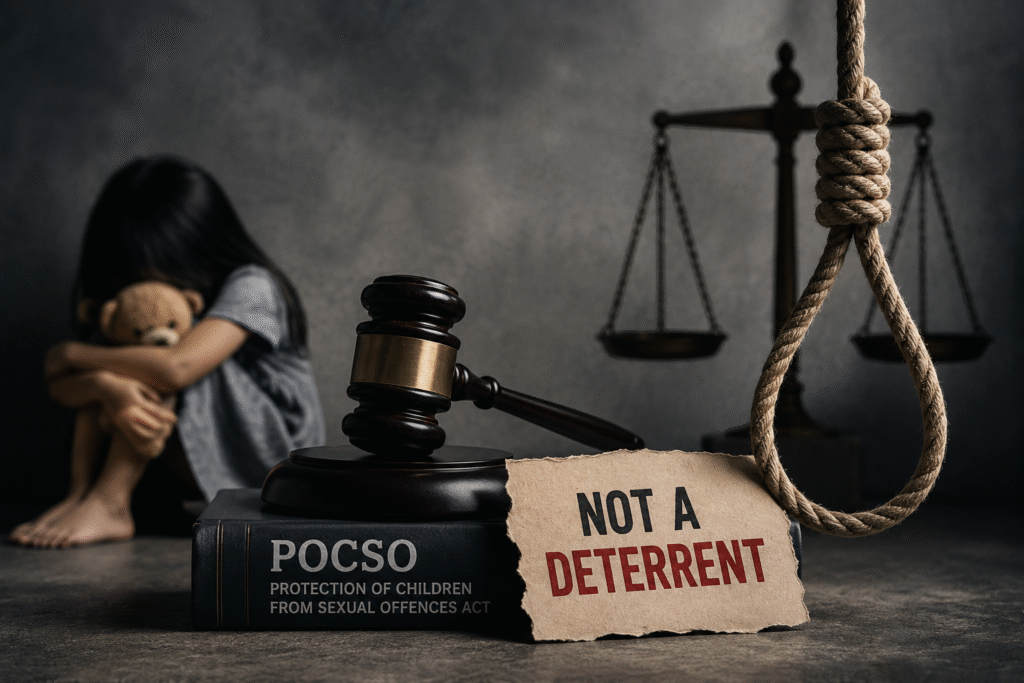
The Protection of Children from Sexual Offences Act 2012 (POCSO) was drafted with the objective to deal with offences against children like child sexual abuse, pornography and widen the scope of reporting offences against children, which weren’t covered under the Indian Penal Code was included. The Bill, passed by the Rajya Sabha on the 18th of July 2019, amends the POCSO Act to include enhanced punishment under various sections of the act, and the maximum punishment in cases of aggravated penetrative sexual assault has been increased to include death penalty.
DEATH PENALTY – BEFORE AND AFTER POCSO
The death penalty as a punishment is awarded only in the “rarest of rare” cases, where the court is of the opinion that it is essential to award such a punishment in order to deter others from committing a crime of such nature, but also as a way of displaying an emphatic expression towards the aggrieved. Prior to the POCSO Act, the death penalty was awarded by the court in the cases of Kamta Tiwari V. State of MP and State of U.P. V. Satish, when the case fell into the category of rarest of rare, and it was essential to sentence the accused to death, not only as a way to deter others from committing an offence of such a scale, but also a way to console the victim’s family.
Post the POCSO Act 2012, the death penalty was imposed only once by the Supreme Court, in the case of Manoharan V. Inspector of Police, whereby the court held that there was no ground to review the judgment of the court passed, sentencing the accused to the death penalty. However, in this case, it is important to note that the accused was not convicted or sentenced under the POCSO Act, as the incident took place before the act was introduced.
It is important to take into consideration that ever since the inception and enforcement of the Act, there hasn’t been a single case in which the accused has been sentenced to death by the Supreme Court; instead, the decision of the lower courts to award a death sentence to the offender has been commuted by the Supreme Court. The Supreme Court, in its latest judgment, decided on 03.10.2019, in the case of Ravi V., the State of Maharashtra, the court accepted the contention of The appellant argued that the mitigating circumstances dominated over the aggravating circumstances thus modifying the death sentence to life imprisonment as the Appellant at the time of committing the offence was aged 25 and the act was committed under the influence of alcohol and there was no evidence placed on record by the prosecution to prove that the possibility of reformation and rehabilitation of the offender were not possible.
There were 14 appeals before the Supreme Court about a sentence of the death penalty imposed under POCSO by the High Court, and out of these fourteen, only in the case of Manoharan V., Inspector of Police, was the accused actually sentenced to death. In all the other appeals, Vijay Raikwar V. State of Madhya Pradesh, Kalu Khan V. State of Rajasthan, to name a few, the Supreme Court commuted the sentence of the death penalty to life imprisonment.
DEATH PENALTY AND THE CONCEPT OF DETERRENCE.
The theory of deterrence is built on the concept or idea that if a sanction imposed by the state is
severe, swift and certain, then the criminal activity will be discouraged. In India, as discussed previously, the death penalty is awarded in the rarest of rare cases, and there has not been a single case in the Supreme Court in which an accused has been sentenced to death under the POCSO Act. The maximum punishment that has been awarded to the accused booked under the POCSO act has been a life sentence.
Capital punishment today is viewed as a prominent tool of symbolic legislation, a strong political statement. This is seen as a political gain by the people in power, and the core issues with regard
to infrastructural requirements, delay in trials, and procedural lapses are not being focused on. It is
important to understand that the certainty of punishment, rather than its severity, could create any
form of deterrence in real society.
In our country, the amendments in law are made after public outrage over the commission of a heinous crime, which in most cases is more of a knee-jerk decision, whereby the new Amendments are brought in as a way of making a public statement.
For instance, in the Nirbhaya Rape case, the Verma Committee was set up in the year 2013, post the public outrage, and the Criminal Law (Amendment) Act, 2013 (Nirbhaya Act) followed suit. Another example is with regard to the Criminal Law Amendment Bill of 2018, which again was introduced post the Kathua case, rape cases were to be tried before the expiry of 2 months; however, the judgment in the Kathua case was pronounced in the month of June 2019, which easily is more than 2 months from when the case was filed before the appropriate court.
With regard to the death penalty under POCSO, it is important to understand that in accordance with
According to the data published by the NCRB, 95% of the cases involving child sex abuse/rape, the
The perpetrator has always been a close family member or friend (i.e. a person of trust), and the actual conviction rate has been less than 15%, by introducing the punishment of death penalty, many would not come forward to report the cases as they wouldn’t want to risk sending their family member to death or try to protect the family name and honour.
Another concern to focus on is post-rape murder. The number of post-rape murders of minor children would increase upon the imposition of the death penalty, as the perpetrator would try to kill the child because leaving the child alive would impose a greater risk of being caught and sentenced to capital punishment.
Tough criminal laws in most cases target the weaker sections of society. As per the NCRB data of the year 2016, out of 279 prisoners who were sentenced to death, 34% of them were from backward classes, which basically means one in every three under trial is either an SC or ST.
Finally, when the sentence is as severe as the death penalty, the standard of proof is inevitably going to be very high. So here the victims would be subject to a lot of questioning during trial, which could, in turn, make their situation worse and put them through more mental agony, which would result in the victims turning hostile.
In the case of Gregg v. Georgia, the judges opined that “Although some of the studies suggest that the death penalty may not function as a significantly greater deterrent than lesser penalties, there is no convincing empirical evidence supporting or refuting this view”. Therefore, it was held that capital punishment is not necessarily an effective deterrent to crime in society.
In the case of Bishnu Deo Shaw v. State of West Bengal, it was opined by the court that there is no concrete evidence to prove that the death penalty has actually led to a fall in the crime rate.
In the case of Shiv Mohan Singh vs. The State, the concept of whether the death penalty would be Acting as a form of deterrence to crimes was discussed, and the same was answered in the negative.
It is important to recognise that deterrence needs to be appropriately backed by a strong bunch of
exhaustive procedures, which entail a much-needed refurbishment of the criminal justice administration system. Therefore, in order to lessen the crime rate in the country, there must be special emphasis on the efficient implementation of the prevailing directions under the POCSO Act. Better conviction rates and reduction of pendency of cases, as opposed to the death penalty, would act as a better deterrent.
Disclaimer
The views and opinions expressed in this write-up are solely those of the author and do not necessarily reflect the official position of Renaissance International Review, its management, editors, or platform.
While the facts and figures presented have been cross-checked by the editorial team to the best of their ability, readers are encouraged to independently verify information where necessary.
For any concerns, clarifications, or objections regarding the content, please contact: contact@rir.world