
The word “caste” we use today comes from the Portuguese and Spanish casta, meaning lineage, breed, or race, a term European seafarers first applied to what they observed on India’s Malabar coast in the 15th century. When Duarte Barbosa, a Portuguese writer and explorer who served in Portuguese India between 1500 and 1517, travelled through Keralam between 1512-15, he used the phrase casta de Nayres (caste of Nairs) to describe warrior groups he encountered who refused to touch or eat with other communities, alongside Brahmans and various occupational groups practising strict endogamy. This social morphology was alien to them: hereditary groups with birth-determined status, occupational specialisation passed down within families, and elaborate rules of purity and pollution that governed who could eat, touch, or marry whom. A complex yet harmonious social web existed before Colonisation; they were, however, never counted, categorised and codified.
In pre-colonial South India, jatis, not castes as we understand them today, functioned as occupational and kinship networks that organised economic life at the village level. These were endogamous groups but also flexible, locally varied, and embedded in complex relationships of temple patronage, lineage authority, and kingship rather than a single hierarchical ladder. Nicholas Dirks, an American academic and a former Chancellor of the University of California, Berkeley, argues that what we now call caste is a modern phenomenon, the product of colonial encounter rather than an unchanged survival of ancient India. Temple communities, territorial groups, warrior subcastes, and occupational associations were some of the significant units of identification, far more fluid than any uniform metonymy of endogamous “caste” groupings.
The first colonial census attempt of 1872 led to the enumeration of caste across the subcontinent, transforming locally varied social arrangements into standardised, nationally harmonised categories. Foucault’s theory of biopolitics finds a place here: apart from law and force, knowledge about populations guides perceptions of people’s social footing, as a tool of governance of the modern state.
The caste system solidified throughout the course up till Independence in antagonising ways while giving rise to several social reformers and towering figures who, through legal and constitutional means, established safeguards against the atrocities entailing the system. The framers of the Indian Constitution envisioned abolishing the system and putting an end to the numerous affirmative actions for social justice. Caste was beginning to get entrenched as a political category.
It entered electoral politics with a vengeance in the 1990s, particularly in Uttar Pradesh and Bihar. The implementation of Mandal sparked massive political mobilisation among OBCs, reconfiguring power equations fundamentally. In Bihar, leaders like Lalu Prasad Yadav emerged as embodiments of OBC assertion, mobilising Yadavs, Muslims, and other marginalised communities into formidable electoral blocs. The “Mandal versus Kamandal” battle- social justice against Hindutva- became the defining political contest of the Hindi heartland. Caste groups that had been historically marginalised now held chief ministerial offices, legislative majorities, and bureaucratic power. This was empowerment and also the making of caste the primary axis of political identity. It became the source of power for those it had once oppressed.
October 2023, Bihar released the findings of its caste-based survey, the first such comprehensive enumeration since 1931. Other Backward Classes (OBCs) and Extremely Backward Classes (EBCs) together constitute 63% of Bihar’s 13.07 crore population. Breaking it down further, EBCs alone account for 36% (4.7 crore), OBCs for 27% (3.5 crore), Dalits (Scheduled Castes) for 19.65%, and upper castes a mere 15.5%. This, more than a statistical exercise, caused a political earthquake. The survey revealed that the combined population of backward classes and Dalits exceeds 80% of Bihar’s population, fundamentally challenging existing power structures and reservation quotas. Proposals for increasing reservation from 50% to 65% were put forth with the argument that the current ceiling does not reflect demographic reality. It exposed the gap between political representation and demographic weight. For decades, upper castes, despite being a small minority, disproportionately controlled state machinery, bureaucracy, and economic resources. The survey provides empirical ammunition for demands of proportional representation, not just in legislatures but in education, employment, and resource allocation.
Indian scholars on caste (such as Anand Teltumbde, Satish Deshpande) warn that counting castes may entrench them further instead of dismantling the system. Teltumbde’s scepticism stems from three concerns: caste cannot be accurately quantified because it is fluid and context-specific; the exercise may devolve into political manipulation; and even accurate statistics provide only a snapshot, not a solution. Satish Deshpande argued that reservation should be dismantled only if a month passes without caste atrocities- a standard that, by any measure, India has not met.
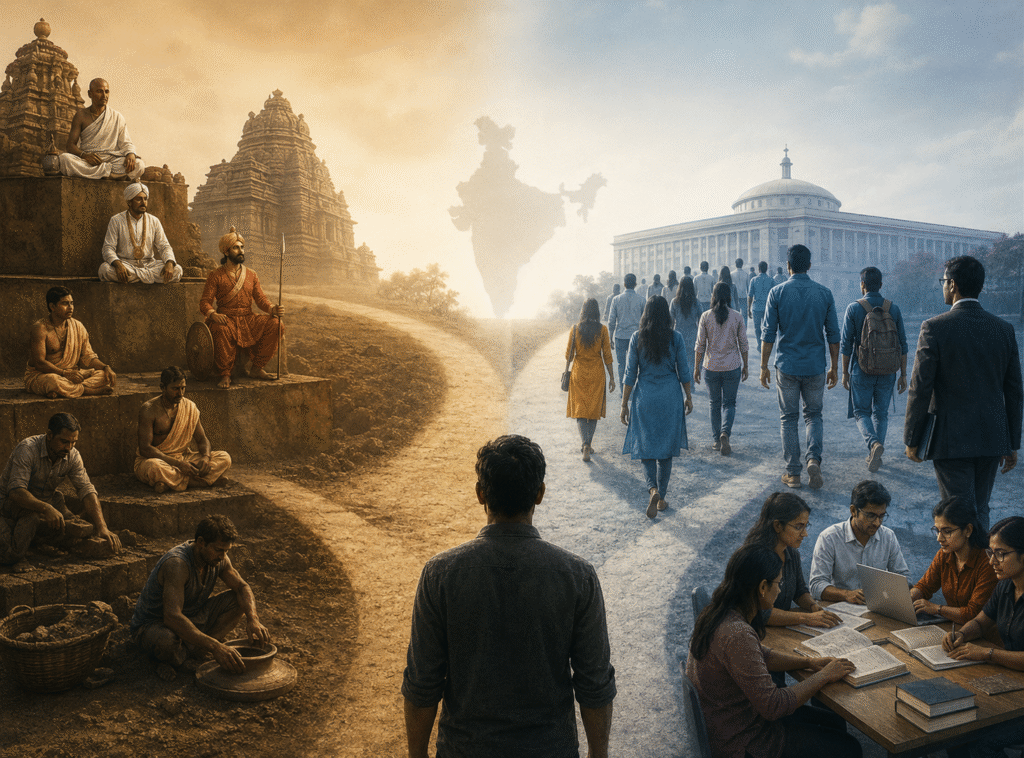
This brings us to the questions that refuse easy answers. Will caste sustain or end? Can caste be the vehicle of its own annihilation? Evidence is contradictory. Forces of modernity & progress on one hand have weakened some traditional caste boundaries, whereas caste never fails to disappear from matrimonial columns, voting behaviour and other pockets of daily social reality.
There are no easy answers. But the questions force us to confront the uncomfortable truth: caste is not a relic of the past. It is a living and breathing reality that shapes how millions of Indians live, work, vote, and die. How everyone sees and treats caste will determine the essence of justice in the world’s largest democracy.
Disclaimer
The views and opinions expressed in this write-up are solely those of the author and do not necessarily reflect the official position of Renaissance International Review, its management, editors, or platform.
While the facts and figures presented have been cross-checked by the editorial team to the best of their ability, readers are encouraged to independently verify information where necessary.
For any concerns, clarifications, or objections regarding the content, please contact: contact@rir.world