
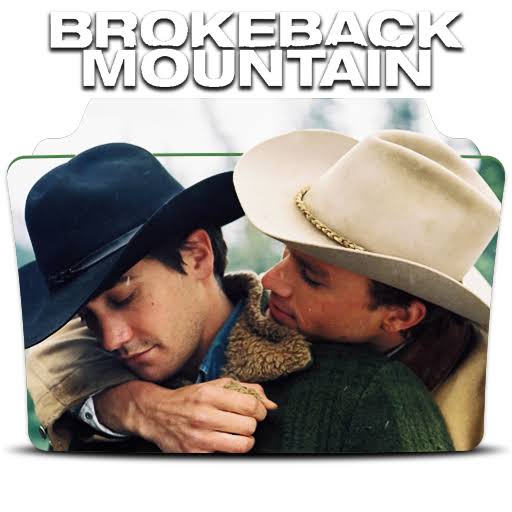
The performing arts have been a clear path for reformers to voice their opinion; to show the audience what went wrong- where, when, and how. Especially to encapsulate an author’s work on screen, is not only mimicking his or her words and characters but also, to add those elements which the author left for the readers to find out for themselves. Proulx has garnered a plethora of issues that are accounted for in her short story. Her major characters are well defined, whom we trace and observe as readers for several years, in keeping with the storyline, to gain a little insight into the functional human in their dysfunctional relationships.
The major characters of the story and the film as well, are Ennis Del Mar and Jack Twist. The former being protagonist in the film version, but the latter is nevertheless made to maintain his significant role. Certain critics have opined that Ang Lee’s movie did reproach to such measures, so as to, subscribe the audience to have an experience that primarily concerns the major character, Ennis, in our case, so as to keep the narrative flow comprehensive. Nevertheless, the author of the story has not knit the narrative with such prejudice. Lee’s deliberate attempt of deviation is a success, as it makes the film personal. We are made highly conscious of the plight of the protagonist, and at the same time invites our emotional faculty to sympathize with him when we encounter the scene where the letter sent to Jack Twist returns as “DECEASED”.
The episode, in both the mediums, captures the audiences’ and the readers’ attention but the cinematic approach of the scene, makes it rather poignant. A distinct filmmaker, when embarks on a journey to retell a story, especially one that has already been documented on pages and in the minds of the readers, his task doubles up. A film-maker’s job merely cannot be restricted to only faithful transcription then, he perhaps has to address the underlying social commentary that the author pens down in the most subtle manner. The amalgamation of the same-sex relation and heterosexual conformity that emerges in the narrative, the part-takers of which are the very figure who dominates the entire storyline, Ennis and Annie Proulx’s “Brokeback Mountain” in the New Yorker in 1997 had stirred the crux of gender groundings, prompting the modern readers to seek enquiry in their conditioned faculties the meaning of mainstream ideology of gender portrayal in the most unfashionable manner. Her short story is widely read and a critically acclaimed piece of literature that later was transported from the pages of the short story onto the screen. Ang Lee’s Brokeback Mountain, released in 2005, is considered to be a faithful representation of the original work.
The modern world asserts the founding of authenticity, it describes the original and portrays the truest reflection of the decadent world, without a coat of whitewash. If one ascribes to the sociological achievement of gender roles that have been stipulated which runs from forefathers to generations to come, one might see a little change in the handling of gender roles. To put it in clear words, out of the fog, the genders evolve as individuals but the dynamics of their contribution to the society remains somewhat restrained or at least is deliberately limited to. It was not until the dawn of the modern era, those eminent female writers took the liberty of presenting the ‘female’ as who they were or rather could be manifested in the truest light. A Dickensian woman is far at bay when put in one room with one of that extracted from the narratives of Virginia Woolf. One plays with the figure; her physical image, notions, mannerisms, whereas the other is humane, breathing in the pages of the narrative. A woman of reality, whose mannerisms are allegorized and subjected to interpretation, given her state of mind and psychological anomalies that evaporates from the cracked wall of social roofing. Anyhow, the entire complex is not binary, neither can be compartmentalized in such a manner. The problems of the sexes are entangled severely outside the visible panorama. It is deeply rooted in one’s psyche and often compressed and chambered to avoid the clash that otherwise would become inevitable, with the anciently ordained dictum of society.
Jack along with their counter-partners, deliver a critical and complex picture of the human life amidst the typical American West. An image that is claustrophobic, psychologically damaging and later culminates into a ball of despair.
In Proulx’s Brokeback Mountain, the wives of the two male figures lack well-defining, at least in comparison with the film version. This issue deprives us to analyze Alma and Lureen in the real light of circumstances. Alma, Ennis’ wife is a typification of a middle-class working woman, whose ideas, and ideals, both are shattered when she discovers her husband’s affair, which she otherwise refers to in the narrative as “nasty”.
Alma is the establishment of societal norms and reflects the obvious standards and pre-dictated roles extended to either of the sexes. Her predicament to Ennis and Jack’s affair is alien-like to comprehend, an abomination to the very least. Her obvious, conditioned, and understandable situation compels her to concede to a divorce. Even though her detachment with Ennis might seem inevitable, the author beams a ray of reality for such situations. Her breaking out from the marriage is not before we observe her tremendous plight to have witnessed the couple’s embrace and her ailing struggle till a resolution has been met. What makes the story even more pragmatic, is the post-modern treatment of it and the social commentary that not only rotates around the major characters but also at the same time, revolves around the interlinked figures who catalytically defines the major figures. For instance, Jack’s promiscuity is cited prematurely by the episode when he is seen with Randall Malone. Later in the narrative, it appears transparent to the audience that Jack would have probably brought Randall to Lighting Flat, Wyoming and perhaps built a ranch. A dream which he entertained having with Ennis. A postmodern reading of the story would not relegate Jack’s lewdness into the background, only if one allows for a moment to not analyze it from the lens of morality. His constant battle to win Ennis on his side and have a life together, till the very end remains unfulfilled, partly because of Ennis’s disapproval given their situation and time.
Brokeback Mountain, accounts for a journey that almost takes a span of over twenty years. In it, we are spectators of a bunch of characters who are young, unconfined, romantic till the time when they are but confined, old and disturbed. Where one might trace this progress in Proulx’s story as sudden and raptured, another might resort to Lee’s version as a continuum.
Ang Lee, in his film, has marvellously documented the mental agony and torments of Alma, a wife whose shift of foundation is pitiful, we sympathize with her and understand even as a modern audience, the chasm she finds herself in. Her crisis is every woman’s crisis, where one is at constant war with an unsustainable circumstance. Our perspective changes when both, the writer, and the director, manoeuvre their pen and pan the camera, respectively, towards Lureen, Jack Twist’s wife. She is a foil to Alma, a woman of the upper class whose sense of management speaks for the intelligent club of the aristocracy. Her physical presence in the narrative is loosely penned, but the director makes ample effort to “flesh-out” her being. Her association with Jack Twist is incidental and briefly outlined though. Critics have opined, Lureen’s presence is more symbolic than can be devised by allotting her equal screen time as Alma. This marks a clear distinction of the stratum in society and how alien one class is from another. For instance, we sympathize with Alma in the film because one has witnessed the turmoil that she undergoes. But in the same film, Lureen’s contribution is dispersedly inclined towards the constitution of marriage.
If the character of Lureen was scanned with a millennial scope, she is the modern woman hence. Her wounds are real as any woman’s but at the same time, layered and invisible. Also, the gradual change in Lurreen’s hairstyle, takes a wild form in the latter end, symbolic of her status, prominence in business; to distinguish herself from the psychologically deprived. Her last appearance in the film is an encounter with Ennis over the phone. She is displayed in the story with little of the expressions that are felt of her and almost sounds cold and flat in any readers’ mind. But Lee’s depiction of Lureen is not as found in the pages of Proulx’s story. She is mantled with tears and boards one last journey of emotional silence before she ceases to exist in the pages. Credit must be extended to Ang Lee, for explicitly displaying the two women of the film, who in their prime yet limited characteristics embody several types and genres of the working women in the modern world. They allegorize the family knit, faithfully attained to depict the polished and apathetic atmosphere of the binaries and their underlying existence.
Perspectivism works interestingly in both versions of the narrative. Not only does it explore the panoramic, scenic beauty but also at the same time, reflects on the gender analysis that we witness separately in the two versions of the art. Proulx’s description of the vast stretching landscape says, Chris Machell in his article “BROKEBACK MOUNTAIN: MASCULINITY, ROMANCE, AND PERSPECTIVE”, documents the harshness of the masculinity, but this has been reframed and reworked into a more subtle and serene presentation by Lee’s film, he added. Proulx has been fierce while languaging her craft which very well adheres prominence to her sheepherder characters, but Ang Lee’s sentimentality adds dimension to the entire narrative that settles the angst and romantic tension, among the two. Film critics have applauded Lee’s appropriation, in praise of phrases and remarks, to have presented a story that illuminates the spirit of the narrative which spoke at length with the descriptive language. Where the short story fell short, but in no way less immersive, the film bridged the crisis.
So, our question as modern readers and civilians of the 21st century, is where does Annie Proulx’s short story determine its position in the modern fabric of socio gender relationship? Or rather, does Ang Lee’s film merely depict or ask questions? The resolution to either require a discourse of discussion where certain episodes of the film and the short story would require revisits and analysis. The social commentary in the film is heavy. Even though a romance at heart, Brokeback Mountain, deals with failed relations, problematized adults, disturbing childhood and above all gender stereotypes. In the episodes where Jack and Ennis are found in their personal clove, Proulx’s tone becomes masculine. We have no substantial matter to stand against such a description for they portray but the truth. Lee’s dramatization further enables the viewers to maintain their course of observation. To have clustered a narrative set in the strict American West and to have subverted the idea of masculinity by putting in the foreground a same-sex couple, is a revolutionary piece. Lee’s adaptation nevertheless strengthens Proulx’s narrative tale and orbits close to the structural and thematic significance. There are very few deviations of course that glitches the parallelism between the two but these glitches are our focal points. They compel us to seek enquiry and enable us to ask the relevant questions. Thus, these disparities tap our interrogative faculty. So even if Lee’s Brokeback Mountain differs by a slight chart in the thematic discourse, the art of characterization, setting and plot, these are imminent and inevitable resources. The transfiguration of one medium to another is subjected to alteration, to manifest the evident and crucial junctures. Otherwise, Proulx’s Brokeback Mountain and Lee’s Brokeback Mountain, are two reflections with one primary narrative.
Disclaimer
The views and opinions expressed in this write-up are solely those of the author and do not necessarily reflect the official position of Renaissance International Review, its management, editors, or platform.
While the facts and figures presented have been cross-checked by the editorial team to the best of their ability, readers are encouraged to independently verify information where necessary.
For any concerns, clarifications, or objections regarding the content, please contact: contact@rir.world