
“It is not enough that men should vote; it is not enough that they should be theoretically equal before the law. They must have the liberty to avail themselves of the opportunities and means of life; they must stand on equal terms with reference to the bounty of nature.” – Henry George, (1839 -1897)
Some people usually consider human beings as the pinnacle of organisms in this world. Many religions also say the same; almost united in expressing that we are ‘perfect’. But that is far from true. Since we are social beings, we need something to govern us in a justified way. And so, one of the systems we devised, in the name of free and equal opportunity for all, is democracy. We exist in a period of questioning. Everyone is questioning everything that is happening in our world. In that case, aren’t we a bit too confident in asserting that democracy is perfect? Don’t you think that this puzzle is incomplete?
Our world and everything within it is far from being perfect. Though in practice one might not be able to predict a perfect plan for anything, it’s always worth trying to be perfect. Analysis of any issue at hand requires a peep into our past; the various ideas that evolved and their successful (or disastrous) implementations. A look at modern systems and ideas. Then followed by our vision for the future.
Democracy: A brief history
We have yet to establish a proper definition of democracy. Legal equality, political freedom, and the rule of law take centre stage. One ancient form existed in Athens. The system was patriarchal and discriminatory. Women, slaves, foreigners, and men under the age of 20 weren’t considered citizens. It was yet a direct government. The people could assemble as they pleased on all political occasions. They took great care in being active in politics as well.
Democracy is often coupled with a republican identity. The history of republics is old. One example is in the year 6 BCE in Vaishali, the capital of the Vajji Confederacy. Some of the Roman democratic principles are in use even today. The Greek model does not give such powers to the people and the elected representatives. But during the Roman Empire, the vote weightage was unequal.
When we jump into the Middle Ages, we see a period dominated by feudal or clergy rule. Even as elections existed, only a small section of the population had the power to cast votes. Most notably, the Magna Carta was signed in 1215. This imposed a restriction on the king in the British Empire. It has since played a pivotal role in the establishment of the English parliament. This also inspired other empires during those periods. The Middle Ages also saw other democratic steps.

The modern period begins with a renewed interest in the Magna Carta. Democratic rule and elections took place in many sovereign states and groups. This was, but with the exclusion of many parts of the general public. Female suffrage was first introduced in the short-lived Corsican constitution. Universal suffrage came only later in the New Zealand Constitution in 1893. This was almost a century after Corsicans.
The French and American Revolutions had a huge impact on bringing basic freedom to many parts of society. The change was slow. It took more than a century and a half for ideal democratic practices to be in place around the world. Many major European colonies opted to become independent in the latter half of the 20th century. These independent states took to drafting democratic constitutions. Only a few held on to the principles of a constitutional monarchy. This ‘wave of democracy’ is continuing in many places.
Justification
Several justifications exist. Some of the social contract theory, Condorcet’s jury theorem, and the Democratic peace theory. The legitimacy of a government is built on the consent of the governed, i.e., an election. This should be followed by governance that reflects the will of the people. As governance is according to the will of the people, better decision-making will be in place. This has also been argued by theories of the ‘wisdom of the crowd’ that arises here. It has been empirically proven that Liberal democracies do not go to war against each other. Democracy is also cost-effective for the economy.
Criticism
Criticisms of democracy are as old as democratic ideas themselves.
In his work, Plato lists 5 forms of government from best to worst. He assumes that the Republic is to be a serious critique of political thought in Athens. Plato argues that only Kallipolis, an aristocracy led by the unwilling philosopher-kings (the wisest men), is a just form of government.
Fraudulent elections are a big concern in many states. Political parties keep accusing one another person who committed the fraud.
Frequent policy changes in business and immigration are likely to deter investment. This can also hinder economic growth. For this reason, many people have put forward the idea that democracy is undesirable for a developing country. Especially in countries where economic growth and the reduction of poverty are top priorities.
Most recently, democracy has been criticised for not offering adequate political stability. An emphasis on the rising coalition governments around the world is also given. This opportunist alliance has the handicap of having to cater to too many ideologically opposing factions. It is also usually short-lived. Any perceived or actual imbalance in the treatment of coalition partners, or changes to leadership in the coalition partners themselves, can very easily result in the coalition partner withdrawing its support from the government.
Biased media have been accused of causing political instability. This can result in the obstruction of democracy, rather than its promotion.
The Future
The future of democracy will be based on our present actions. What we do in the coming few Decades matter the most.
The democratic ideals are and should be different according to the people living in a state. If a state tries to copy an idea from another state that is doing well (like democratic functions), the result can go both ways. This can’t always be predicted.
To bring about a good democratic reformation, changes must begin with the people themselves and not only the constitution.
Benjamin Franklin once quoted, “Democracy is two wolves and a lamb voting on what to have for lunch.” The only thing that keeps the lamb off the lunch menu is the fact that much of the states are republic — not a perfect one, but still one nonetheless. What that implies is that the country is not a private concern of the rulers. It is a “public matter” and belongs to each one of us regardless of caste, creed, gender, or ethnicity. This demands that our rulers are elected and not inherited. They must rule for the common good. This is an aspect of governance on which philosophers, such as Plato and Aristotle, wrote volumes. This is, of course, only possible when there is a set of laws, and those elected as leaders follow them
both in letter and spirit.
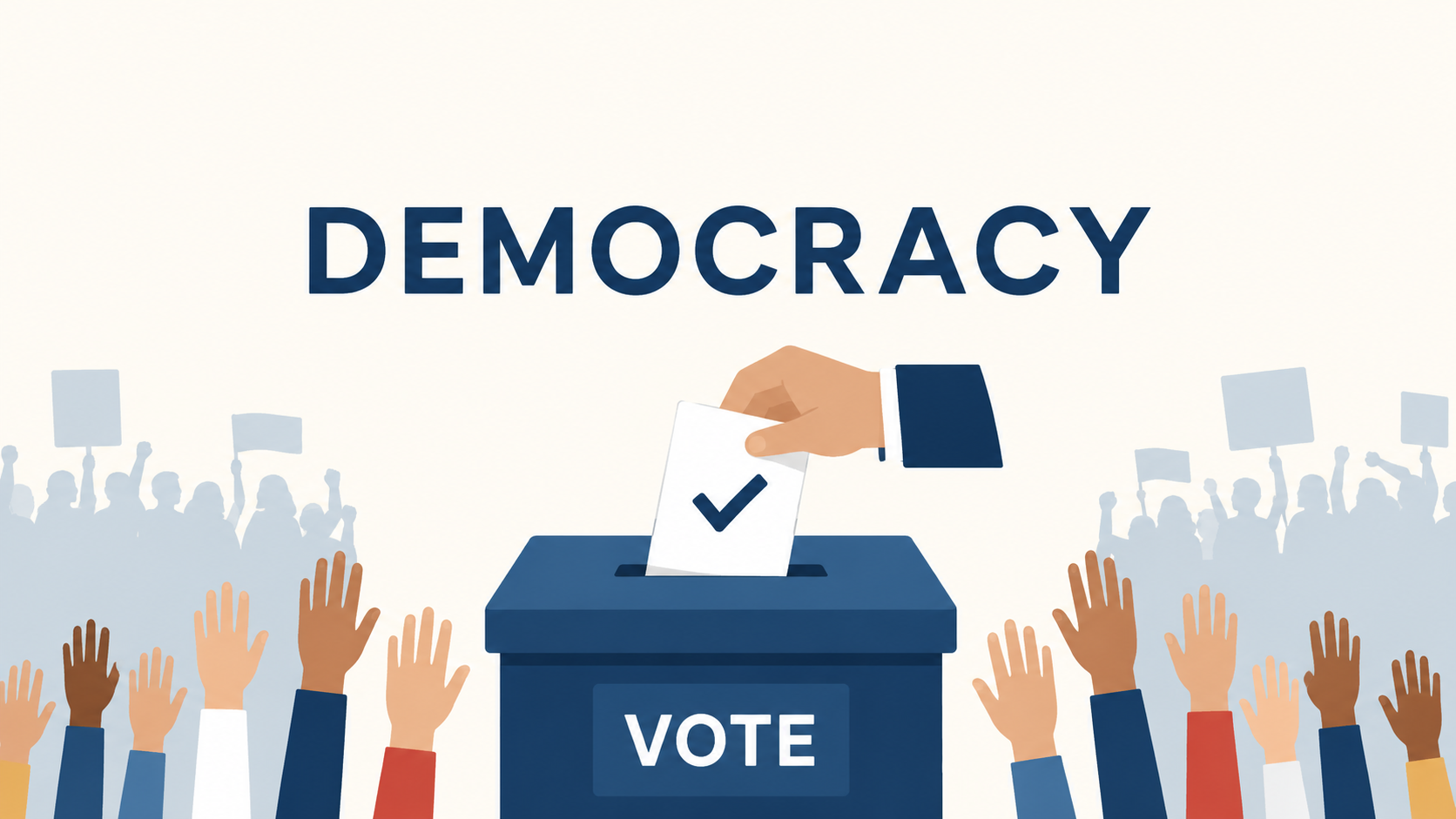
The hallmark of democracy is that it permits citizens to take part in making laws and public policies. This is through regular elections to choose leaders and by voting in assemblies or referenda. Their participation should be meaningful and effective. If democracy is to be real and not a sham, citizens must understand their interests, know the relevant facts, and be able to critically check political arguments. Each of those things presupposes education. As the world advances, the possibility for democracy to become more digital will also increase. This can include many things. Being able to get the proper statistics to present before a meeting. Letting the people directly give their recommendations during a session. The possibilities are endless. The modern world is driven by databases. There will come a time
when databases alone will be the basis for policies. In such a situation, if the general public misses out on gaining the correct information, the very ideals upon which democracy is built will shatter. As we see even today, such a situation will be dealt with by the people themselves. Violence can erupt. Coup attempts can take place. In the end, it will be a blame game with no one winning. Humanity may even stop existing in that dark period.
Unless and until the rights of a person are available to them, democracy will not survive. In many parts of the world, attempts to overthrow governments might be happening. By the time you finish reading this, perhaps someone has sacrificed themselves for the ‘good of the people’. Whether that sacrifice was for democracy or not, we will never know. There is, but one thing that we do know; We can change democracy for the better.
Disclaimer
The views and opinions expressed in this write-up are solely those of the author and do not necessarily reflect the official position of Renaissance International Review, its management, editors, or platform.
While the facts and figures presented have been cross-checked by the editorial team to the best of their ability, readers are encouraged to independently verify information where necessary.
For any concerns, clarifications, or objections regarding the content, please contact: contact@rir.world